Showing posts with label Asperger's Syndrome. Show all posts

Tuesday, June 10, 2014

Good Citizen

Good Citizen 2014
Each year at my kids' elementary school one student from each classroom is awarded the "Good Citizen" Award.  This year it went to our daughter.  She had to prove herself throughout the entire school year.  Not only being a good classroom citizen, but modeling that citizenship for other students.

Last week I received the following, very touching, email from her teacher:

          "I wanted to let you that just prior to our last IEP meeting for Audrey last month, I had told the other therapist that Audrey was doing so well, that she was at the top of the list for receiving the citizenship award because of her accomplishments. 

          Although I usually struggle with this award, Audrey stands out as the best receiver of it.  This year, Audrey will be receiving my class' citizenship award.  Again, she has come so far in many areas this year, is academically gifted, and has soared on the social side as well. There is no doubt that every single student has respect for Audrey, and it is very clear that she had to earn their respect on her own. In addition, she is a good citizen despite her personal challenges and NEVER breaks the rules.  She has learned to help others, respect them, and encourages good behavior as well.  Thank you so much for the opportunity to allow me to have Audrey this year.  She is amazing and I have no doubt that she will continue to succeed.

          She is also so very lucky to have parents like you and your husband.  Please accept this award for yourselves as well because she could not be a good citizen without your support. THANK YOU for all you have done for your child."

While we knew upon attending the awards ceremony, Audrey did not know she'd be receiving this award. We were beaming and when her name was called I watched her head pop up in surprise.  I wish I could have seen the surprise on her face as well.  

We are so proud of you, Boo.  You have come so far this year and we have no doubt you're going farther than we can imagine.  Remember, you have it in you to continue this success.  Always be proud of your accomplishments and know it's your hard work and good character that got you there!  We love you!

Thursday, May 15, 2014

The look you're not getting


One of the traits for Asperger's Syndrome is the inability to make eye contact.  One of the reasons, I believe, this to be is because of all that occurs on our faces during a typical conversation.  You are talking, your lips are moving, your eyebrows are arching, your forehead is wrinkling, you're waving your hands, and you're still talking.  To a person with AS, who typically is also dealing with Sensory Processing Disorder, this is an overload of information to process at once.  We, those of us familiar with AS, know this and typically work around the social "rule" of making eye contact.  We look for ways to teach our children to make eye contact to be more socially accepted.  We beg teachers to let our kids doodle while getting instruction so they can concentrate on words alone.  


Look OR Listen NOT Both (google images)
Even as we work on that have we ever really thought about if from the child's point of view?  Recently I came across something Audrey wrote.  It is simple and to the point and didn't offer a ton of insight, but it did put me in my place.

"I heart being nice.  But sometimes I have a tough time doing so in person.  I'm better when I can't see someone's face.  Kinda weird".  

First and foremost my heart melted because she hearts being nice!!  (I'm totally doing something right)  Then my heart broke because she sees this as "kinda weird".  Whenever one of my kids thinks they are weird or, more often than not, that Mom is weird I chant, "Embrace your weirdness".  And with my Aspie I always tell her, "wired, not weird".  She does these things because of the way her brain is wired.  Embrace that too!  Most importantly, it's for us to heed her statements.  Accept that it's tough and be okay with that.

So, my point(s) are this.

**If someone is not making eye contact with you don't jump to conclusions and think they are rude.

** Consider for a moment that this person is uncomfortable looking at you while you speak because of all the sensory information you are putting out there to be processed at once.

**If you encounter a person like this do not be afraid to ask them if they'd rather not look at you.  You aren't being rude by asking, you are being considerate and in tune to your audience.

**We all have our own idiosyncrasies; embrace the way you are wired.

Thursday, January 9, 2014

Read All About It

Here is a list of books that have been helpful in our journey with Asperger's Syndrome.  This is not an end-all list; there are many wonderful books out there.  I will add more as I come across them.    If you have some to share with me, please leave a comment.

***********************************
When Audrey first started OT (Occupational Therapy) this book was suggested to us by her therapist.  It helped us to understand so much of what she was dealing with when it came to her Sensory Processing Dysfunction.

The Out-of-Sync Child  Written by:  Carol Kranowitz & Lucy Jane Miller

From Amazon's Book Description:  The Out-of-Sync Child broke new ground by identifying Sensory Processing Disorder, a common but frequently misdiagnosed problem in which the central nervous system misinterprets messages from the senses. This newly revised edition features additional information from recent research on vision and hearing deficits, motor skill problems, nutrition and picky eaters, ADHA, autism, and other related disorders.

********************************
When Audrey was officially and clinically diagnosed with ASD we bought this book to read with her.  She felt so empowered to have this information and know there were other kids like her.

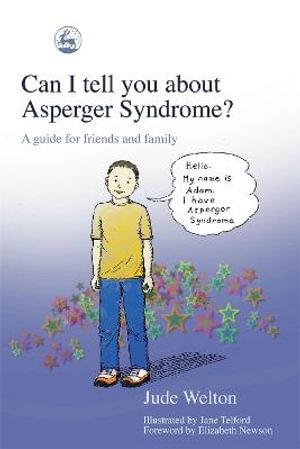
Can I tell you about Asperger's Syndrome?  Written by: Jude Welton

From Amazon's Book Description:  Meet Adam - a young boy with AS. Adam invites young readers to learn about AS from his perspective. In this book, Adam helps children understand the difficulties faced by a child with AS; he tells them what AS is, what it feels like to have AS and how they can help children with AS by understanding their differences and appreciating their many talents. This book is ideally suited for boys and girls between 7 and 15 years old and also serves as an excellent starting point for family and classroom discussions.

********************************* 
School Success for Kids with Asperger's Syndrome  Written by:Stephen M. Silverman & Rich Weinfeld

From Amazon's Book Description:  Hundreds of thousands of children face life with Asperger's syndrome, a mild form of autism spectrum disorder that affects a child's language and social skills. Kids with Asperger's have average to above-average intelligence, but often have obsessive interests, are socially awkward, and do not understand the subtleties of language and conversation. With concentrated effort on the part of parents and educators, these children can begin to overcome the difficulties of this disorder and find success in school and life. 

School Success for Kids with Asperger's Syndrome covers topics such as recognizing and diagnosing Asperger's syndrome, addressing the needs of students with Asperger's, implementing successful practices in the classroom, working with the school system, and providing interventions in the home to help develop needed skills.

********************************************************
How To Teach Life Skills to Kids with Autism or Asperger's  Written by:  Jennifer McIlwee Myers, Foreword by:  Temple Grandin

From Amazon's Book Description:  In the real world, people on the autism spectrum need the same kinds of day-to-day skills everyone else needs to be functional!


It's true. No matter how high-functioning children with autism or Asperger's may be or may become, they function better as adults if they’ve had the chance to learn basic skills, from being on time to good personal hygiene. But many reach adulthood without those skills.


Enter Jennifer McIlwee Myers, Aspie at Large.
Coauthor of the groundbreaking book Asperger's and Girls, Jennifer's personal experience with Asperger's Syndrome and having a brother with autism makes her perspective doubly insightful.
Jennifer can show you how to:
  • Create opportunities for children to learn in natural settings and situations
  • Teach vital skills such as everyday domestic tasks, choosing appropriate attire, and being polite
  • Help individuals on the spectrum develop good habits that will help them be more fit and healthy
  • Improve time management skills such as punctuality and task-switching
  • And much more!
 Jennifer's straightforward and humorous delivery will keep you eagerly turning the page for her next creative solution!

******************************************************************


Identity Revealed

Photo courtesy of Google Images

When I started this blog I used our daughter's nick name, "Boo".  I did this for two reasons.  One, I wanted people who read this to be able to identify with Asperger's Sydrome itself and not with just the individual that I identify Asperger's with.  Two, I wanted to somehow protect our daughter's true identity.

I have been thinking a lot about this and decided that my reasons didn't make perfect sense.  Coincidentally not much about Asperger's makes perfect sense.  There is a saying out there in the Autism community:  "If you've met one person with Autism you've met ONE person with Autism".  This is a great quote because   there are incredible differences among children and people on the spectrum in how they learn, think, feel, behave and communicate.  People on the spectrum have many of the same characteristics that help diagnose Autism, but they are as individual as snowflakes; no two people with Autism are alike.

Our daughter is Audrey.  She is our "Boo".  At the time of this entry she is nine years old.  She has Asperger's Syndrome.  She does not define herself as Autistic.  You may read this blog and identify with a lot of her traits characteristic with Asperger's, but she is not like you, not like your child.  She is her own person.  I hope relating to her for who she is, her true identity will actually help you identify more with your own experiences as a parent to a child on the spectrum, particularly Asperger's, or as someone living with ASD.

Be true to yourself, do not hide your real identity.


Thursday, December 5, 2013

"One of those well meaning moms"

Photo courtesy of Google Images
When Boo (now age 9) was three years old we went to a birthday party for one of her preschool classmates.  There were 8-10 preschoolers and as many moms.  We were all in close proximity.  While the other kids were running, playing, and having a lot of fun interacting with each other my Boo clung to my side, crying, screaming, and thoroughly not enjoying herself.

At the time I cared what other people thought of my parenting, and I was mortified that my child was the only one screaming during what should have been a fun couple of hours.  Soon it was time to eat a snack of half-moon cookies.  I remember that Boo had calmed down, but was still visibly upset.  As she sat in the chair at the table she began sobbing looking at her cookie then looking up at me.  Looking back at her cookie she reached towards it ever so slowly, the closer she got the harder she cried.  It took me only seconds to realize she did not want to touch it.  The feel of the frosting on her fingers was more than she could bare.  There I was again, caring what other parents thought of me and my child, feeling embarrassed that my child was the only child using a fork to eat her cookie. 

Finally it was time to go outside.  The minute we stepped out of the house a switch flipped inside Boo.  She was happy again, calm, and content to play in the yard.  

In the midst of all the chaos one of those well meaning moms asked, "Has she been diagnosed with Asperger's Syndrome?".  I will never forget how that one question made me hate that mom.  How dare she even suggest something be wrong with my precious daughter.  What the hell did she know!  I remember telling her she did not have Asperger's (even though I didn't know much about AS I knew Boo did not have it).  I remember complaining to my close friends how other moms never know when to mind their own business.  I never admitted that deep down inside I knew something was up with Boo.  That incident was the beginning of what would later be diagnosed as Sensory Processing Disorder (SPD). 

That birthday party was an overstimulation of senses that Boo could not process all at once.  In the noise department we had several adults talking at once, along with several children yelling & playing.  In the visual department we had pretty packages of all different sizes and shapes, balloons in many colors floating around, and a diversity of people's faces in close proximity.  In the taste & smell department we had sticky frosting, sweet cookies, fruit juices, and an array of other foods.  ALL!  AT!  ONCE!  Still don't know how that feels to a child with SPD?  Try this little experiment:  

Go into a room, light some scented candles.  Turn the tv & radio up loud, turn on all of the lights, call in your family and ask them to talk to you.  Get the dog barking, call up your best friend on the phone, grab some colorful scarves and dance to the radio.  ALL!  AT!  ONCE!  
Now shut it all off.  You can breathe again.  That was the switch that flipped when we took Boo from the party to the outside.  

Years later I no longer care what other people think of my parenting, my children's behavior, or even their misbehavior.  Years later I wish I could go back to that "Well Meaning Mom" and give her a hug and a thank you.  She got us thinking, she made us realize that we had something to research, she had us questioning Boo's behavior.  She was not rude or imposing.  She truly was one of those well meaning moms. 

I learned that I could trust other moms, trust my gut, and listen to my child.  After all, I too am "One of those well meaning moms".  

*********************
If you think your child might have Sensory Processing Disorder or want to learn more about children with SPD check out  The Out of Sync Child by Carol Kranowitz .  

Sunday, December 1, 2013

Building Blocks

Our first indication that Boo was unique or had Autistic tendencies was when she was between 15-20 months.  We were sitting on the floor with her playing with wooden building blocks.   The blocks were outlined in colors, ABCs on one side, numbers on the other side, complete with matching letter pictures.  She was meticulously stacking a tower as tall as she was.  

The blocks were aligned straight as could be with capital letters, colors, numbers, and pictures all following in their own suit.  We would turn the blocks upside down, twist them out of alignment, or match a number to a letter side.  She would turn around to get a new block, come back to notice our changes and fix it perfectly before she moved on to stacking the next block.  

Photo courtesy of Google Images
My husband's strongest memory comes from yet another set of building blocks.  She had a set of nesting blocks.  Here is his recount of that memory in a recent email to our Autism Lead at our school:  

"I wanted to share with you that we first noticed Boo’s behaviors when she was still a baby.  Boo was always sensitive to environmental changes and loud noises.  As she grew she was always content to play with her toys and did not require much interaction from other kids or us to keep her happy. 

One of the first telling experiences was when she was about 3 years old.  Boo had multi-color nesting blocks with numbers, letters, and colors on each side of the boxes.  Most kids would have been happy to stack the blocks anyway possible and make the stack high until it tumbled over.  Boo on the other hand would stack the blocks one at a time largest on the bottom to smallest on the top.  The numbers, letters, colors, and edges would always align and increase sequentially.  As a test, I would sit with her and as she stacked each block and turned to grab the next I would move, change the order, or mismatch the numbers or letters of the blocks.  When she turned around with the next logical block she would observe the change, pause, turn back around and place the block in her hand on the floor and return to the stack and correct all of the mistakes that I had induced.  She would then turn and grab the next block and continue the stack, each block perfectly aligned at the edge with all of the numbers, letters, and colors matching.  Anytime I would change something she would again correct any mistake and then continue to stack the blocks.  She never seemed to grow tired of this play."

Throughout the years Boo was was intrigued by any toy that enabled her to sort by color, shape, and size.  It did not matter if that toy was "too young" for her.  If she could stack it in ascending order, group it, or create an organized pattern it was a toy that kept her busy for hours.  At that time we did not know she was paving the way for our journey to Asperger's Syndrome.  

Years later while working with Boo's psychiatrist at Children's National Hospital we would learn that her fascination with patterns, detail to ascending order, and need for organization was a telltale trait of Autism Spectrum Disorder (ASD).  

We still have the wooden building blocks in a closet.  It is one toy I cannot bring myself to be rid of.  They are more than just a toy.  They are more than a memory.  They are what shined a light into Boo's soul.  They are the blocks that built a metaphorical stairway for us to climb towards answers; one perfectly aligned step after another in the most beautiful pattern you can imagine.  The blocks are a symbol of how unbalanced the tallest tower can be; crashing down with the slightest touch.   Even that is okay, we have learned from a very beautiful and gifted girl that with patience and attention to detail we can rebuild.